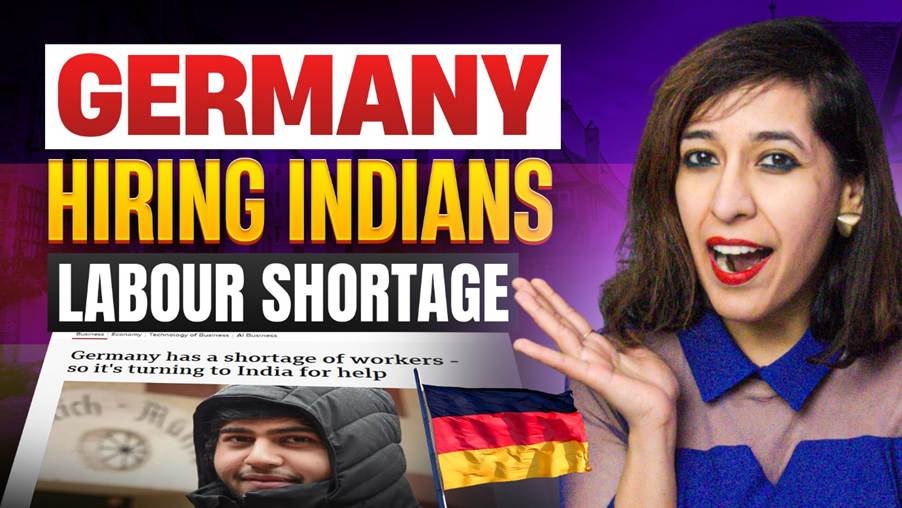
The recruitment drive of Germany to hire Indian workers is no longer just news; it is a demographic reality. Germany is presently witnessing the greatest labour shortage in decades, and to maintain economic stability, it requires between 288,000 and 400,000 foreign labourers each year.
Indian professionals can now walk into a situation where Germany has laid the red carpet for them by increasing their yearly quota of skilled-worker visas from 20,000 to 90,000.
1. Why Germany is Looking to India
Germany is one of the world’s leading economies; however, the size of its labour force is decreasing due to the retiring Baby Boomer population, leaving several jobs vacant.
India’s Young Population: While Germany becomes older, India enjoys the highest number of young people aged below 25 years.
Ideal Workforce: There are millions of Indians graduating in STEM annually whose skills are highly compatible with Germany’s technology-based industries.
An Economic Cooperation Strategy: This is more than just immigration; this is a deliberate strategy by the two countries.
2.Who is Eligible? (Two Main Paths)
In 2026, you will be either a Recognized Skilled Worker or not – and you will not need a job offer in order to move anymore!
Path A: The “Recognized Skilled Worker”
Your eligibility is automatic in case you hold a degree or a vocational certificate that is recognized by Germany in its full range.
Criteria: Your degree should be verified using the Anabin database; if it ranks as an H+, then your degree equals a German one.
Immediate Path: You may submit your application for either the EU Blue Card (in case you have a job offer) or the Job Seeker Visa.
Path B: The Opportunity Card
Should you lack a job offer, you may apply via the points system of the Opportunity Card, requiring no less than 6 points in such areas as:
Educational Qualifications: 4 points for a partially recognized degree.
Professional Experience: 3 points if you have worked for five years in your sphere of activity.
Languages: 3 points if you speak German (B2), or 1 point if you speak English (C1).
Age: 2 points if you are younger than 35.
3. In-Demand Industries in 2026
It applies to a range of industries and is not limited to “Software Engineering” alone.
IT and Tech Industry: Developers in Artificial Intelligence, Analysts in Cybersecurity, and Architects in Cloud Computing. (Tip: An IT professional with three years of experience is eligible for a visa even without a college degree).
Health Care Industry: A severe lack of Registered Nurses, Doctors, and Geriatric Caregivers.
Engineering Industry: Engineers who specialize in mechanical, electrical, and civil engineering, particularly for “Green Energy”.
Vocational Training (Ausbildung): Germany has started recruiting Indians for vocations such as bakers, butchers, electricians, and logisticians. With “Dual Training,” you can earn while you learn.
Public Sector: There is an emerging high demand for kindergarten teachers and educators.
4. The Five-Step “No-Agent” Procedure
An intermediary is not required for relocation to Germany. Take these five steps for a successful “No-Agency” approach:
Step 1: Categorize Yourself
Choose between pursuing a high-skill professional designation or a vocational training (Ausbildung) track. Be sure to tailor your application according to the “Shortage Occupation List.”
Step 2: Prepare German-Standard Documents
The HR manager in Germany expects documents in a certain format. You will need a CV, which should be professional, well-structured, and formatted in tabular form. All certificates must be translated and saved in PDF format.
Step 3: Utilize Trustworthy Job Portals
Scam yourself into applying on legitimate platforms only:
Make it in Germany: Official government portal
Arbeitsagentur: Federal Employment Agency portal
StepStone & LinkedIn: Best for international opportunities.
Step 4: Apply Directly to Companies
Submit applications directly through corporate career portals. German recruiters prefer direct and concise communication. In shortage sectors, companies may even sponsor you in your “Fast-Track” visa process.
Step 5: Visa and Recognition
Once you get an offer letter or accumulate opportunity card points, visit VFS Global. By 2026, the processing time for Indian workers in shortage sectors is expected to be as low as two to four weeks.
5. Why This Matters to You in the Future
It’s not just a career choice, but rather a complete life change.
Permanent Residence: If you hold an EU Blue Card and speak German at a beginner’s level, then you’re entitled to permanent residency status after 21 months.
Citizenship: Citizenship is granted after five years of legal stay, and you can maintain your old passport (dual citizenship).
Quality of Life: Germany boasts high salaries, top-notch social security services, and a balanced life-work routine (up to 30 days of paid holiday a year).
Conclusion
Germany is inviting foreign professionals because it needs their skills. If you are ready to study the language (the B1/B2 level is a benchmark), embrace a new culture, then 2026 is the golden era to realize the “German Dream.”
Start now: Verify your diploma on Anabin and start learning German.
Navigating competitive job markets, tailoring your CV to specific industry requirements, and managing visa sponsorship can feel like a full-time job in itself. If you want hands-on, expert guidance to streamline the process and boost your success rate, my Job Assistance Programme is here to help.
Email me at Yourknowledgebuddy@gmail.com to get started today.